North Sandusky on Rand Lake, about half way across the southern tip of Illinois.
Last year we both read the story of George Rogers Clark, Long Knife by Alexander Thom, and the trek of his troop of soldiers, untrained backwoodsmen, to save this area from British control, inspiring Indian attacks during 1777-78—USA Revolutionary War times. We were basically following Clark’s trek in this area. We had the advantage of wheels and good weather, they walked in flooded fields, up to their waist in freezing,
 early February, weather to Vincennes. In a short time they captured this British post. He continued to protect this area by making friends with most of the Indian tribes. Clark financed this campaign with his personal funds and from loans he personally guaranteed. He was finally partially reimbursed by Virginia for his expenses. Clark was an older brother to William Clark of Lewis and Clark fame. George Rogers Clark, in our estimation, is a great American hero, yet his efforts aren’t recognized by many Americans. Most of the Revolutionary War emphasis is placed upon the fighting of George Washington on the east coast. Clark and his “Mountain Men” closed Washington’s backdoor to British activity. Clark’s extraordinary heroic efforts were recognized by Washington.
For our delicious supper from the freezer we feasted on Spicy Sweet and Sour Pork by Frank Meyner. This was one of many frozen casseroles we brought with us from our Sunday school class fund raiser. Olivia also made several casseroles to add to the freezer. After supper we visited with two other nomads passing through this area. One from Huntsville, AL, the other from Burlington, IL. Both were heading home.
Tuesday, April 6 we worked on the blog all morning, finally posting Letter 2. This was a lazy day. After lunch we explored the south end of Rand Lake. It was built in 1965 and has about six corps of engineer parks. Very nice. Two have received stimulus funding and are closed for improvements. The one we are in is very nice already. We wondered how they are improving the others, but they were closed to our inspection.
The wind blew, and BLEW, and BLEW! All day.
We found
 Burton’s Café, famous for “White Pie.” We asked about the Burtons, Olivia’s maiden name, and they were no longer the owners. Mrs. Burton’s name was Ruth, and since Daddy liked pie we just had to buy a slice.
We asked several places about George Rogers Clark and they said “Who?” One library directed us to the Rand Lake College, so we drove there. A very nice security guard led us to the history department. The expert was to receive an award momentarily, so we were given his email. He told us, via e-mail, of another book about Clark - Clark of the Ohio by Frederick Palmer.
Wednesday, April 7, the wind BLEW all night and was predicted to do so all day, so we decided to stay put another day. Then we decided it wasn’t so bad and we headed across Illinois to Vincennes, Indiana following George Roger Clark's path, so to speak. We could see where the country could be flooded. There were several rivers and very few hills.
While we were still in Illinois we saw signs about the Wabash Cannonball Bridge and its location, so we struck off to see it. “Listen to the jingle the rumble and the roar as she glides along the woodland ore the hills and by the shore …”
When we arrived we realized we could cross the Wabash here. First it was a railway bridge, now it is an automobile toll bridge. The lady in the
 toll booth said they averaged between 5-800 vehicles a day.
The bridge was a narrow one-lane affair and there was a
 man on the bridge driving nails back into the boards. On the other side, we weren’t one mile into Indiana when our trailer tire hub nut came off (unknown to us at the time) and then, shortly, our left rear axle started smoking. We are so blessed that the man behind us passed and flagged us down just as it started smoking. Fred looked in rear view mirror and saw the smoke. The bearings were gone, scattered on the roadway behind us. We were on a small two lane road with no shoulder and very little traffic. Several people stopped to help.
We called Good Sam Emergency road service. People still stopped to help. Among all the cars and 18 wheelers that past was a
 big tractor with tall and wide extensions. He had to go half off the road to get around. He was very careful to miss us and a telephone pole just ahead of us. It wasn’t long before he came back and passed us again!
Within one hour help arrived and the mechanic
 knew what to do. First, he jacked up the trailer. Then he said he didn’t need to loosen the lugs, because there was nothing holding the tire on! He removed the tire, leaving us with three trailer tires and an axle about 5 inches off the pavement. Then he followed us at 10 mph, about 5 miles to the large
  Coomes Automotive Automotive repair shop in the outskirts of Vincennes, again part of the Good Sam’s network. After assessing the situation, we were here for the night, so they ran electricity to us.
 We think this is the same wheel we had trouble with in East Texas our first trip out. It doesn’t have anything to do with lubricating as it still had plenty and was freshly repacked just before our trip.
Please don’t feel sorry for us. It’s all part of our adventure we share with you. Our luck is good! Too many good things are happening for us! We know we will have problems and are prepared to do what is necessary to continue our venture. Life is a bowl of cherries, including pits! You win some and you lose some. We were safe and blessed the tire didn’t come off while moving.
We decided after inspecting another wheel’s bearings, we should replace them all. They ordered parts and closed shop.
We were also blessed as this was our destingation for the day so we unhooked and went into the town of Vincennes which was named in honor of a French Canadian in 1732, he built a fort here to protect the claims of France in the New World. We drove down
 Indiana’s first Main Street. It was after hours so we were not able to go into the visitor’s center.
 The city’s Historical Marker read:
“Vincennes in the American Revolutions: After taking Kaskaskia, on the Mississippi below St Louis, in July 1778, George Rogers Clark, acting under Virginia authority, sent Father Pierre Gibault, as his envoy, to Vincennes. Gibault convinced the villagers there to take an oath of loyalty to the Americans. In early August, Capt Leonard Helm arrived to take command of Ft Sackville. On December 17, British forces under Henry Hamilton recaptured the fort. Clark with some 160 men reached Vincennes on February 23, 1779, after an eighteen-day march through flooded country. The move caught Hamilton by surprise. Two days later he surrendered. The Fort, renamed Patrick Henry, remained in American Hands.”
When news of his victory reached General George Washington, Clark's success was celebrated and was used to encourage the alliance with France. Washington recognized his achievement had been gained without support from the regular army in men or funds. Virginia capitalized on Clark's success by laying claim to the whole of the Northwest, calling it Illinois County, Virginia. Clark’s efforts helped the US acquire this vast region north and south of the Ohio River in the peace settlement of 1783. Four years later the Continental Congress established the “Territory Northwest of the River Ohio,” a political entity known as the Old Northwest, which evolved into the states of Ohio, Indiana, Illinois, Michigan, Wisconsin and the eastern portion of Minnesota. The continental congress wrote it’s first ordinance called the Northwest Ordinance that guides the annexation of all new lands into the USA and it is still the way we annex any new land today.
There are more things to see, but it was getting dark, so we headed back to the trailer for supper. Our weather has been very good, maybe a little hot. It has been unusually warn according to the locals. After dark, a cold front moved through with thundershowers. This night we enjoyed Pam Stoker's chicken & dumplings. Thanks, Pam!
Thursday, April 8 we woke up to cold and wind. The parts arrived and we waited our turn. Then we found one of them wasn’t up to their standards and they needed to return it and get a new one. So, we will spend a second night on the parking lot of Coomes Automotive. No big deal. While we waited we toured the
There are more things to see, but it was getting dark, so we headed back to the trailer for supper. Our weather has been very good, maybe a little hot. It has been unusually warn according to the locals. After dark, a cold front moved through with thundershowers. This night we enjoyed Pam Stoker's chicken & dumplings. Thanks, Pam!
Thursday, April 8 we woke up to cold and wind. The parts arrived and we waited our turn. Then we found one of them wasn’t up to their standards and they needed to return it and get a new one. So, we will spend a second night on the parking lot of Coomes Automotive. No big deal. While we waited we toured the
 George Rogers Clarks National Historical Park, viewed the movie which was an edited form of a History Channel movie. Inside was
  Clark’s statue, in full uniform, surrounded by seven murals depicting his story. Outside the
  crabapple trees were in full bloom. In the visitor’s center was a display of the
  Frontiersmen that played a big roll in settling this area. Clark, Father Pierre Gibault Jesuit priest, Tecumseh, and Henry Hamilton, British commander at Ft Sackville (Vincennes).
Vincennes was also the home of President William Henry Harrison and we saw
 his home along with the historical buildings of the first capitol of Indiana. If you remember this Harrison caught pneumonia at his inuagral speech and died 30 days in his term. He wasn’t able to accomplish anything. Fred speculates, because of his lack of activity, he may have been one of our greatest Presidents!
Vincennes was also the birthplace and home of Red Skelton. He was born to humble circumstances, and went on to become one of the best known comedian entertainers of the twentieth century. He was given the nickname “Red” for his bright red hair. His mother was widowed just before Red’s birth and she struggled to raise her four children. Red worked many jobs as a child. He spent most of his early years on the road during the summer as a member of a medicine show. In 1929 he started appearing in Minstrel Shows. In 1941 he had his own radio show. In 1942, he put his feet in concrete outside the Grauman Theater in Hollywood. The footprints were gifted to Vincennes University from Red’s estate.
During WWII while in the Army he helped build up soldiers spirits by going to camps. In 1951, he began his 20 year run on television featuring many characters including "Freddie the Freeloader" and "Clem Cadidlehopper."
Here in Vincennes there is a Red Skelton Bridge, Street, Performing Arts Center and Museum as well as a
 mural in downtown. Throughout Red’s successful career he never lost sight of his upbringing and the needy individuals around him. He truly was an amazing artist in many senses. We remembered his wonderful, hilarious, and CLEAN comedy unlike the standup comedians of today.
Friday, April 9, finally all was finished with the wheels and we left town, following the Ohio River
 to old Shanteetown. All we found was the Hogdaddy’s saloon
  with a line of bras.
We stopped for the night at Cave in the Rock State Park in the town of Cave in the Rock. We found a place to set up and went to see this exciting cave. We walked over the hill and
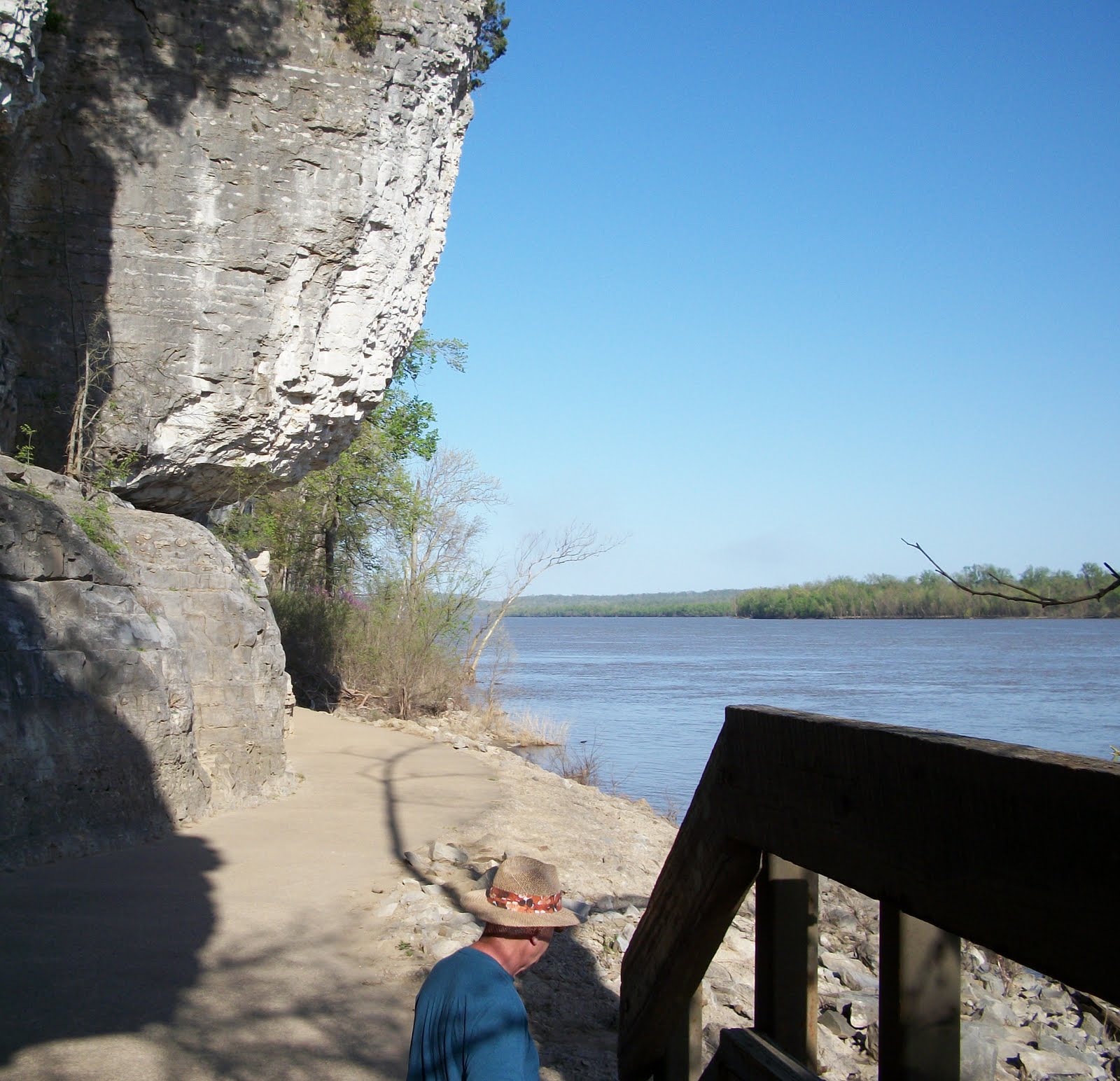 down to the cave. The walk was more interesting than the cave that was only about 100 yards deep.
 As we walked along the Ohio we could see the  ferry crossing.
Saturday, April 10 we drove over to the free ferry crossing and walked on pretending we were pioneers floating down the Ohio to a new home. Along this stretch, the only thing interesting were the
  small bluffs where the cave was. Back at the trailer we admired the flower
  bed of dandelions and violets along our pad.
As we followed the scenic River Road we had been told about a Chocolate factory at Golconda, so we turned off the road and ended up right in the middle of the Pope County FFA Antique Tractor Show. We had never been to one before so we strolled down the street admiring the reconditioned tractors. Fred wished Alan had one of the
  Ford models.
Along the road we began seeing lots of blooming Dogwood trees in the woods.
Arriving in Metropolis, IL,population 6,500, we searched out the Harrah’s Casino where we parked in the big spots for trucks and RV’s. We both went in to scout it out, then came back for an early supper. Fred went back to play Texas Hold’em. Olivia stayed to work on this blog and catch up on reading. It was noisier than Ferris Avenue with all the buses and trucks running their diesels. We hoped we could sleep. The things we do for those we love!
ferry crossing.Saturday, April 10 we drove over to the free ferry crossing and walked on pretending we were
pioneers floating down the Ohio to a new home. Along this stretch, the only thing interesting were the  small bluffs where the cave was. Back at the trailer we admired the flower
  bed of dandelions and violets along our pad.
As we followed the scenic River Road we had been told about a Chocolate factory at Golconda, so we turned off the road and ended up right in the middle of the Pope County FFA Antique Tractor Show. We had never been to one before so we strolled down the street admiring the
 reconditioned tractors. Fred wished Alan had one of the
  Ford models.
Along the road we began seeing lots of blooming
 Dogwood trees in the woods.
Arriving in Metropolis, IL,population 6,500, we searched out the
 Harrah’s Casino where we parked in the big spots for trucks and RV’s. We both went in to scout it out, then came back for an early supper. Fred went back to play Texas Hold’em. Olivia stayed to work on this blog and catch up on reading. It was noisier than Ferris Avenue with all the buses and trucks running their diesels. We hoped we could sleep. The things we do for those we love!
 Fred said “Don’t ask how he did.”
Sunday April 11 we walked up the street to the First United Methodist Church of Metropolis. Their preacher was amazing, along with being a great preacher he had a beautiful voice too. People we met in the pews told us to be sure and see the statue of
  Superman and the Daily Planet. It seems there really was a Superman and the town of Metropolis.
  For comments please email Olivia@bobheck.com or Fredharrington@yahoo.com or if you wish to be taken off our list email the same address.
Our next letter will be “The Land Between the Lakes.”
Sunday April 11 we walked up the street to the
 First United Methodist Church of Metropolis. Their preacher was amazing, along with being a great preacher he had a beautiful voice too. People we met in the pews told us to be sure and see the statue of
  Superman and the Daily Planet. It seems there really was a Superman and the town of Metropolis. For comments please email Olivia@bobheck.com or Fredharrington@yahoo.com or if you wish to be taken off our list email the same address.
Our next letter will be “The Land Between the Lakes.”

 boats gathering & fishing across the upper end of Bull Sholes lake, called home and went to bed early. We decided to stay one more night here.


 hitching posts at the campsites. We hoped no one camped next to us with horses. At least there was not a site on the other side of us. It is forested with hardwood trees, with a few scattered cedars.